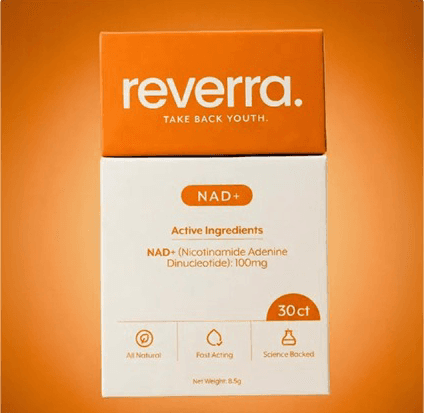
What Is NAD+? What This Molecule Does in the Body
Guide7 min readUpdated

The short answer
NAD+ is a helper molecule that sits inside every cell in the body. Its job is to carry small pieces of fuel during the work of turning food into energy. Cells also use it for repair and upkeep. The body makes it, spends it and rebuilds it all day.
On this page8 sections
NAD+ is the everyday helper that cells use to turn food into energy and to keep their own parts in good repair.
What does NAD+ do inside a cell?
It acts as a shuttle. It picks up tiny charged pieces during the breakdown of food and drops them off at the next step. Food does not become energy in one jump. It comes apart in many small steps, and this shuttle moves the pieces along.
When it picks up a piece, it turns into a slightly different form called NADH. When it hands that piece off, it switches back to its first form. Cells run that switch over and over, second after second. A 2018 review of lab research describes these two forms as the cell's energy carriers when food is turned into usable energy.
Much of this work happens inside tiny parts of the cell called mitochondria, which act as the cell's power plants. Inside those power plants, a set of steps known as the citric acid cycle pulls energy out of food pieces. The shuttle takes part at several points along the way.
Energy is not the only job. Cells also call on this molecule when enzymes patch up damaged DNA. A second family of enzymes, called sirtuins, needs it as a working partner. A 2020 review of lab research covers how the molecule is made, used and reused inside cells, and which questions in this field are still open.
So one small helper sits in the middle of two kinds of work. It helps cells make energy. It also helps cells keep their own parts in good order.
Why does one molecule do so many jobs?
Because the same chemical trick works in many places. Picking up and handing off small charged pieces is a basic move in living chemistry. Once a cell has a carrier that does that well, many different enzymes can use it. That is why the same helper shows up in energy work and in repair work.
Where does the body get NAD+?
The body builds it. Cells do not simply absorb a finished supply and store it away. They assemble it from smaller starting materials, then keep assembling more.
Some starting materials are forms of vitamin B3. Another is an amino acid that comes from protein in food. There is also a shorter route, often called the salvage route. It takes a leftover piece from a used molecule and builds a fresh one from that piece.
The short route saves effort. Building from scratch takes more steps and more raw material. Building from a leftover piece takes fewer steps. A 2015 review of animal and human studies looks at what controls levels inside cells and how those levels change during aging.
This is also why so much supplement research looks at starting materials rather than the finished molecule. The body is already set up to build. Researchers study what happens when more building material is available.
How quickly do cells use NAD+?
Very quickly. Cells hold no large reserve. They make it, spend it and make more in a steady loop that never stops. A 2021 review of lab research reports that it is made and used so fast that it lasts only minutes in some tissues.
That speed changes how the number should be read. The amount in a tissue at any moment is a balance. On one side is how fast cells build it. On the other side is how fast cells spend it. A single reading does not say which side moved.
It also explains why the body keeps the salvage route running. A fast spender needs a fast supply line.
What happens to NAD+ as the body ages?
Levels appear to drift down. A 2021 review of animal and human studies reports that levels decline with age in several kinds of living things, including rodents and people.
A 2024 review of animal and human studies also reports a decline with aging, and notes that findings so far come mostly from preclinical research. Preclinical means work done in cells and in animals, before trials in people. That same 2024 review notes that human trials have started.
Why the decline happens is still being worked out. Researchers watch both sides of the balance. One side is how much a cell builds. The other side is how much a cell spends on its daily work. Age could shift either side, or both.
What are NAD+ precursors, and what have trials tested?
A precursor is a starting material. The body takes it in and builds the finished molecule from it. Several forms of vitamin B3 act this way.
One of them is nicotinamide riboside, a form of vitamin B3 studied as a starting material. A 6-week randomized crossover trial in healthy middle-aged and older adults found that it was well tolerated and raised NAD+ in the blood [Small human study].
A crossover trial means each person takes part in both arms of the study at different times. Each person takes the study ingredient during one stretch and a placebo during another. That design lets researchers compare each person with themselves.
Blood is easier to sample than muscle, brain or liver. That matters for how far the results reach. A 2025 review of human trials reports that data on levels inside human tissues are sparse, and come from a limited number of studies.
Questions about how to use any supplement belong with the label directions and with a healthcare provider.
What studies show
Here is what each cited paper reported, in plain words.
- A 2018 review of lab research describes NAD+ and NADH as the carriers the cell uses when food is turned into usable energy.
- A 2020 review of lab research covers how the molecule is made, used and reused, and sets out the open questions in this field.
- A 2021 review of lab research reports that it is made and used so fast that it lasts only minutes in some tissues.
- A 2021 review of animal and human studies reports that levels decline with age in several kinds of living things, including rodents and people.
- A 2015 review of animal and human studies examines what controls levels inside cells and how they change during aging.
- A 2024 review of animal and human studies reports a decline with aging, says findings so far come mostly from preclinical research, and notes that human trials have started.
- A 6-week randomized crossover trial in healthy middle-aged and older adults found that nicotinamide riboside was well tolerated and raised blood NAD+ [Small human study].
- A 2025 review of human trials reports that data on levels in human tissues are sparse and come from a limited number of studies.
What is not known yet
The gaps are as important as the findings. Here is what the cited papers did not measure or could not show.
The 6-week crossover trial in healthy middle-aged and older adults looked at blood levels and at how well the ingredient was tolerated [Small human study]. It was one short study in a small group of people.
How blood readings line up with readings inside organs is still unclear. A 2025 review of human trials reports that measurements in human tissues are sparse, so the inside picture remains thin.
Much of the groundwork sits in cells and animals. A 2024 review of animal and human studies says findings so far come mostly from preclinical research. Results in cells and animals do not carry over to people on their own.
Basic chemistry questions are open too. A 2020 review of lab research lists unresolved questions about how the molecule is made, used and reused.
Speed adds another gap. A 2021 review of lab research reports that the molecule lasts only minutes in some tissues, which makes a single snapshot hard to interpret.
And the long view is missing. None of the papers cited on this page followed people for years to see what a change in blood levels means over a lifetime.
Key takeaways
- NAD+ is a helper molecule that cells use to move small pieces of fuel while food becomes energy, and it also works with repair enzymes.
- A 2018 review of lab research describes NAD+ and NADH as the cell's energy carriers during that work.
- The body builds it from starting materials and from a salvage route, a subject covered in a 2015 review of animal and human studies.
- A 2021 review of animal and human studies reports a decline with age in rodents and in people.
- A 6-week crossover trial in healthy middle-aged and older adults found that nicotinamide riboside was well tolerated and raised blood NAD+ [Small human study].
- A 2025 review of human trials reports that data from human tissues are sparse.
This is a fast moving area of research, and the plain summary is short. Cells need this helper for energy work and repair work. Levels appear to shift with age. Human data are still limited, especially inside tissues. Anyone weighing a supplement that involves it can bring the question to a healthcare provider, who can look at the whole picture.
Reverra products are for healthy adults. Talk to your healthcare provider before starting any supplement, especially if you take medication, manage a condition, or are pregnant or nursing.
These statements have not been evaluated by the Food and Drug Administration. Reverra products are dietary supplements and are not intended to diagnose, treat, cure, or prevent any disease.
Common questions
What is NAD+ in simple terms?
It is a small helper molecule found in every cell. Its full name is nicotinamide adenine dinucleotide. Cells use it to carry tiny charged pieces from one chemical step to the next while food is turned into energy. It also works with enzymes that handle repair jobs inside the cell.
What does NAD+ do during energy production?
It works as a shuttle. It picks up small charged pieces from food breakdown and hands them off further down the line. A 2018 review of lab research describes NAD+ and NADH as the cell's energy carriers when food is turned into usable energy inside cells.
What is the difference between NAD+ and NADH?
They are two states of the same carrier. NAD+ is the form that is ready to pick up a small charged piece. NADH is the form that is already carrying one. Cells switch between the two states constantly, which is how the carrier keeps moving pieces along the energy line.
Where does the body get NAD+?
The body builds it rather than storing a large finished supply. Starting materials include forms of vitamin B3 and an amino acid from protein. A salvage route also rebuilds fresh molecules from leftover pieces. A 2015 review of animal and human studies examines what controls these levels in cells.
Do NAD+ levels change with age?
A 2021 review of animal and human studies reports that levels decline with age in several kinds of living things, including rodents and people. A 2024 review of animal and human studies also reports a decline with aging and notes that findings come mostly from preclinical research.
How long does NAD+ last inside the body?
Not long at all. Cells make it and spend it in a fast, continuous loop rather than keeping a big reserve. A 2021 review of lab research reports that it is made and used so quickly that it lasts only minutes in some tissues of the body.
What is an NAD+ precursor?
A precursor is a starting material. The body takes it in and builds the finished helper molecule from it, often through a short salvage route. Several forms of vitamin B3 act as starting materials. A 2020 review of lab research covers how the molecule is made, used and reused.
What did the nicotinamide riboside trial find?
A 6-week randomized crossover trial in healthy middle-aged and older adults found that nicotinamide riboside was well tolerated and raised NAD+ measured in the blood [Small human study]. A crossover design means each person took part in both arms of the study at different times.
Are sirtuins connected to NAD+?
Yes. Sirtuins are a family of enzymes that need this helper molecule as a working partner, so their activity is tied to the supply inside the cell. A 2020 review of lab research covers how the molecule is made, used and reused, and the questions still open.
Does a blood reading show NAD+ inside organs?
Not reliably, based on current evidence. Blood is simply easier to sample than muscle, liver or brain tissue. A 2025 review of human trials reports that data on levels in human tissues are sparse and come from a limited number of studies so far.
What is still unknown about NAD+ in people?
The long view is missing. A 2024 review of animal and human studies says findings come mostly from preclinical research, though human trials have started. No paper cited here followed people for years to see what a change in blood readings means over time.
How should someone use an NAD+ supplement?
Follow the label directions. This article is general education about what the molecule is and what research has reported, not guidance for any individual. Anyone with questions about a supplement, including people who take medication or manage a condition, should talk with their own healthcare provider before starting it.
References
- 01NAD(+) metabolism and its roles in cellular processes during ageing, 2021 PMID 33353981
- 02NAD(+) homeostasis in health and disease, 2020 PMID 32694684
- 03Evolving concepts in NAD(+) metabolism, 2021 PMID 33930322
- 04NAD(H) and NADP(H) Redox Couples and Cellular Energy Metabolism, 2018 PMID 28648096
- 05Roles of NAD(+) in Health and Aging, 2024 PMID 37848251
- 06NAD⁺ in aging, metabolism, and neurodegeneration, 2015 PMID 26785480
- 07Chronic nicotinamide riboside supplementation is well-tolerated and elevates NAD(+) in healthy middle-aged and older adults, 2018 PMID 29599478
- 08NAD(+) precursor supplementation in human ageing: clinical evidence and challenges, 2025 PMID 41083806
Keep reading
This article is for general information and is not medical advice. These statements have not been evaluated by the Food and Drug Administration. Reverra products are not intended to diagnose, treat, cure, or prevent any disease. Consult your healthcare provider before starting any supplement.