Is Cordyceps Real? What the Science Says
Question9 min readUpdated
The short answer
Is Cordyceps real? Yes. It is a real genus of fungi that grows on insects. Two species show up in supplements: Cordyceps militaris and Cordyceps sinensis. Both have been studied in people. Several of those human studies are small, so the findings are early and mixed.
On this page8 sections
Cordyceps is a real group of fungi with real human trials behind it, and several of those trials are small with mixed results.
What is Cordyceps, and is it a real organism?
Cordyceps is a living thing, not a brand name. It is a genus, which is a scientific group of closely related species. These fungi live on insects and other small animals in the wild.
The life story is simple. A spore lands on an insect. The fungus grows through the body of the host. Later, a stalk pushes out into the air and releases new spores. That stalk is the part people collect and dry.
Two names appear on supplement labels. One is Cordyceps militaris. The other is Cordyceps sinensis. Scientists now place the second species in a related group called Ophiocordyceps. Sellers kept the older name, so both names point to the same wild fungus.
A fungus has two parts worth knowing. The first is a web of fine threads called mycelium. It works like a root system and stays out of sight. The second is the fruiting body, the part that pushes above the surface. In Cordyceps militaris, that part is bright orange and shaped like a small finger.
Is it a mushroom? Not exactly, though it is a close relative. A mushroom is the fruiting body of certain fungi, usually a cap on a stem. Cordyceps makes a stalk instead. Shops still place it beside mushroom powders, which is why the two get mixed up in conversation.
People in parts of Asia have used these fungi in traditional practice for a long time. That history explains why the name feels familiar. History on its own is not evidence. The evidence sits in the trials, and those come later on this page.
Is the insect fungus story true?
Yes, the insect part is true. Fungi in this group are parasites of insects. They grow inside a living host and use it as food. When the host dies, the fungus pushes a stalk out of the body.
The best known image is a caterpillar with an orange stalk growing from its head. That image is not a trick. Collectors in high mountain areas of Asia dig these up by hand. Supply is limited, because the work is slow and the growing areas are remote.
Related species do much the same thing to ants, moths and beetles. Each species tends to favour certain hosts. Films and games borrowed the idea and made it frightening. The real biology is much narrower than the fiction.
Human bodies are a poor match for these fungi. They are built around insect hosts and insect body chemistry. Material sold as a supplement is also dried and processed, so it is not a living organism in the jar. The body handles it as food.
That leads to a fair follow-up question. If the fungus needs an insect, how can companies sell it in bulk? The answer is farming, and that is the next section.
Is the Cordyceps in supplements the same as the wild kind?
Often it is not the same. Wild Cordyceps sinensis is picked by hand and is scarce. Cordyceps militaris, by contrast, grows well indoors. Growers raise it on rice or grain in trays, with no insect involved. That is why this species fills so many products on shelves.
Labels can describe two different materials. Some say fruiting body, which is the orange part above the surface. Others say mycelium, the threadlike part, often grown on a bed of grain. The two materials are not identical, and the label is where that detail lives.
Lab names appear as well. Cordycepin and adenosine are compounds that growers and testing labs often measure in this fungus. A compound named on a label tells a reader what was measured in that batch. It does not tell a reader what will happen in a body.
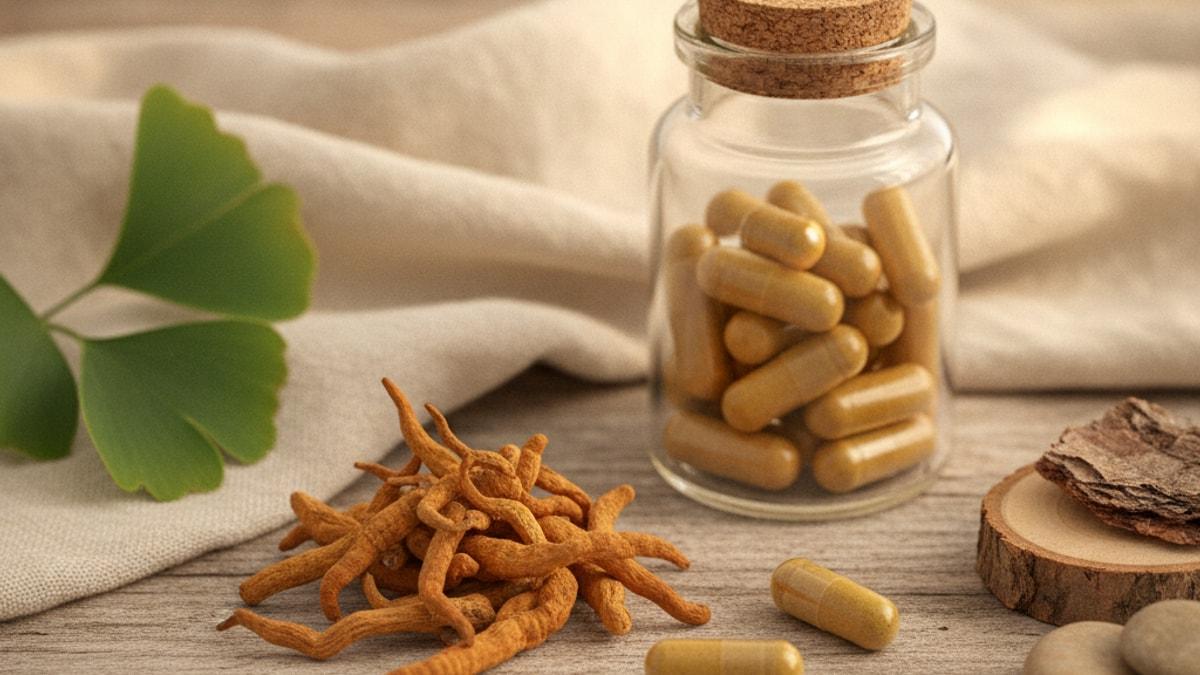
The formats vary too. Cordyceps is sold as dried pieces, powders, capsules, teas and drinks. Anyone with a question about use should follow the label directions. A healthcare provider can answer the rest.
So the honest answer has two halves. The organism is real, and the farmed material is real Cordyceps. It is simply not the same material that a collector digs out of a mountain meadow. Readers who want more questions answered can look there as well.
Has Cordyceps been tested in people?
Yes. Several trials have given Cordyceps to adults and measured what changed. In the better designed ones, some people got the real material and others got a placebo. A placebo is a dummy with no active ingredient. That design helps separate a real change from wishful thinking.
Immune markers in blood are one target. In a 2015 trial in 79 healthy Korean men, four weeks of Cordyceps militaris raised natural killer cell activity compared with placebo. [Human study] Natural killer cells are white blood cells that respond to threats. The same four-week trial also reported a rise in lymphocyte growth compared with placebo. [Human study] Lymphocytes are another family of white blood cells.
A later study used a drink. In a 2024 trial in 20 healthy men and women in Thailand, a fermented Cordyceps militaris beverage was compared with placebo over eight weeks. [Small human study] That eight-week trial found raised natural killer cell activity compared with placebo in a subgroup of 10 women. [Small human study]
Exercise is the other common target. In a 2004 trial in 22 endurance-trained male cyclists, a Cordyceps sinensis supplement did not change peak oxygen uptake. [Small human study] That same trial in trained cyclists also found no change in time-trial results compared with placebo. [Small human study]
Reviews pull several trials together. A 2025 review of human trials in mostly young active people reports longer time to exhaustion with Cordyceps. The same review of human trials says findings on aerobic fitness were not consistent.
Why do people hear such different things about it?
Because the studies are not all asking the same question. Five differences explain most of the confusion.
Species differ. Cordyceps militaris and Cordyceps sinensis are separate organisms. A result in one does not settle anything about the other.
Materials differ. Threadlike mycelium grown on grain is not the same as a dried orange fruiting body. Neither one matches wild material from a mountainside.
The people enrolled differ. One trial may enrol young men only. Another may enrol a mixed group. Trained athletes and people who rarely train can respond in different ways.
The measures differ. A blood marker is a number from a lab. A time-trial is a task on a bike. Feeling alert during a work day is something else again. These are three separate questions.
Size matters. In a trial with a handful of people, one or two unusual responses can move the average. A finding inside a subgroup is a starting point for later work, not a settled answer.
Marketing adds the last layer. Advertising copy tends to repeat the hopeful result and drop the flat one. Reading the actual findings fixes that, and how the studies are read covers the basics. Short answers to common questions sit on a separate page.
What studies show
Four papers carry most of the weight on this page. Here is what each one found, in plain words.
The first looked at immune markers over four weeks. In a 2015 trial in 79 healthy Korean men, Cordyceps militaris raised natural killer cell activity compared with placebo. [Human study] That same trial also reported a rise in lymphocyte growth compared with placebo. [Human study] Both numbers come from blood samples, not from how the men described their days.
The second used a fermented drink. In a 2024 trial in 20 healthy men and women in Thailand, the drink was compared with placebo across eight weeks. [Small human study] That trial found raised natural killer cell activity compared with placebo in a subgroup of 10 women. [Small human study] A subgroup is a slice of the larger group, so the number of people behind that result is very small.
The third tested endurance. In a 2004 trial in 22 endurance-trained male cyclists, a Cordyceps sinensis supplement did not change peak oxygen uptake. [Small human study] Peak oxygen uptake is a measure of how much oxygen the body can use during hard effort. The same trial found no change in time-trial results compared with placebo. [Small human study] A flat result is still a result, and it belongs in the picture.
The fourth is not an original study. A 2025 review of human trials in mostly young active people reports longer time to exhaustion with Cordyceps. The same review of human trials reports that findings on aerobic fitness were not consistent. A review gathers trials rather than running one, so it shows the spread of results.
What is not known yet
Plenty is still open. The gaps are as useful as the findings.
Blood markers are not daily life. The 2015 trial in 79 healthy Korean men measured activity in blood cells, so it cannot show how the men felt. [Human study]
Small numbers limit what can be said. The 2024 trial in 20 healthy adults in Thailand rested its natural killer cell finding on a subgroup of 10 women. [Small human study] That same trial cannot show what would happen in a much larger mixed group. [Small human study]
One sport is not every activity. The 2004 trial in 22 endurance-trained male cyclists measured cycling tasks only, so other kinds of effort were not tested. [Small human study]
The endurance picture is unsettled. A 2025 review of human trials reports inconsistent aerobic fitness findings across the studies it gathered.
Several questions sit outside these papers entirely. None of them put the two species side by side in the same group of people. None of them compared one supplement format with another. Long-term use across years is not covered by the research described here. The effect of growing method, fruiting body against mycelium, is also untested in these four papers.
Key takeaways
- Cordyceps is a real genus of fungi that grows on insects, and the caterpillar images are genuine.
- Supplement material is often farmed Cordyceps militaris grown on grain, which is not the same as wild material.
- In a 2015 trial in 79 healthy Korean men, Cordyceps militaris raised natural killer cell activity compared with placebo. [Human study]
- In a 2024 trial in 20 healthy adults in Thailand, a fermented drink raised natural killer cell activity in a subgroup of 10 women. [Small human study]
- In a 2004 trial in 22 endurance-trained male cyclists, a Cordyceps sinensis supplement did not change peak oxygen uptake or time-trial results. [Small human study]
- A 2025 review of human trials reports longer time to exhaustion, with inconsistent aerobic fitness findings.
So the plain answer holds up. The organism is real, the farming is real, and the human research is real but early. Anyone weighing a Cordyceps supplement for their own situation should talk to a healthcare provider, who can look at the whole picture.
Reverra products are for healthy adults. Talk to your healthcare provider before starting any supplement, especially if you take medication, manage a condition, or are pregnant or nursing.
These statements have not been evaluated by the Food and Drug Administration. Reverra products are dietary supplements and are not intended to diagnose, treat, cure, or prevent any disease.
Common questions
Is Cordyceps a real fungus or just a marketing name?
It is a real fungus. Cordyceps is a scientific genus, which means a group of closely related species. These fungi live on insects in the wild. The name is also used on supplement labels, but the organism behind the name is genuine and well described by biologists.
Does Cordyceps really grow on insects?
Yes. In nature, a spore lands on an insect and the fungus grows through the host. A stalk then pushes out and releases new spores. The caterpillar photographs seen online are real. Farmed Cordyceps for supplements is usually grown on grain instead, with no insect involved at all.
Is Cordyceps a mushroom?
Not exactly, though it is a close relative. A mushroom is the fruiting body of certain fungi, usually a cap on a stem. Cordyceps also makes a fruiting body, but it grows as a stalk. Shops often place it beside mushroom powders, which adds to the confusion.
What is the difference between Cordyceps militaris and Cordyceps sinensis?
They are two separate species. Cordyceps militaris is bright orange and grows well indoors on grain, so it fills many products. Cordyceps sinensis is the wild species collected in high mountain areas of Asia. Scientists now place that second species in a related group called Ophiocordyceps.
Can Cordyceps infect a person?
These fungi are built for insect hosts. Each species tends to favour certain insects, and human bodies are a poor match for them. The stories in films and games are fiction. Material sold as a supplement is dried and processed, so the body simply handles it as food.
Is wild Cordyceps the same as the cultivated kind?
No. Wild material is collected by hand and is scarce. Cultivated material is grown indoors under controlled conditions. Products may use the fruiting body or the threadlike part called mycelium, which is often grown on grain. The label is the place to check which one is inside.
How should someone use a Cordyceps supplement?
Follow the label directions. An article cannot set an amount or a plan for any individual person. Anyone taking medication or managing a condition should speak with a healthcare provider first. A provider can look at the full picture, including anything else that person already takes regularly.
Does Cordyceps do anything for exercise?
Human research on exercise exists, but it is limited and the results do not line up. Some trials measured endurance tasks and others measured oxygen use during hard effort. The research described on this page is early, so no firm answer is available for exercise questions yet.
Does Cordyceps affect the immune system?
Some human trials measured immune markers in blood after adults took Cordyceps for several weeks. Those trials are described in the body of this page, with their sizes and evidence labels. Blood markers are not the same as how a person feels, so findings need careful reading.
Is the research on Cordyceps strong?
It is early. Several of the human trials are small, which means a few unusual responses can move a result. Species, growing methods and the people enrolled differ from study to study. Larger and longer trials in varied groups would make the overall picture much clearer.
What is cordycepin?
Cordycepin is a compound found in this fungus, and testing labs often measure it in raw material. Seeing it named on a label tells a reader what was measured in that batch. It does not tell anyone what will happen inside a person's body after use.
References
- 01Cordyceps militaris Enhances Cell-Mediated Immunity in Healthy Korean Men, 2015 PMID 26284906
- 02A randomized controlled clinical trial examining the effects of Cordyceps militaris beverage on the immune response in healthy adults, 2024 PMID 38580687
- 03Cordyceps Sinensis (CordyMax Cs-4) supplementation does not improve endurance exercise performance, 2004 PMID 15118196
- 04Ergogenic Aid by Cordyceps: Does It Work??, 2025 PMID 40768109
This article is for general information and is not medical advice. These statements have not been evaluated by the Food and Drug Administration. Reverra products are not intended to diagnose, treat, cure, or prevent any disease. Consult your healthcare provider before starting any supplement.