What Is Inulin Made From? Plant Sources Explained
Question8 min readUpdated
The short answer
What is inulin made from? Inulin is made from plants. It is a fiber, a long chain of plant sugars. Chicory root is a common source. Jerusalem artichoke and agave store it too. Makers soak the chopped root in hot water, then purify what comes out. Human studies so far are small, so findings are early.
On this page8 sections
Inulin is a plant fiber, taken from roots and tubers such as chicory and Jerusalem artichoke, and gut bacteria feed on it.
Which plants is inulin made from?
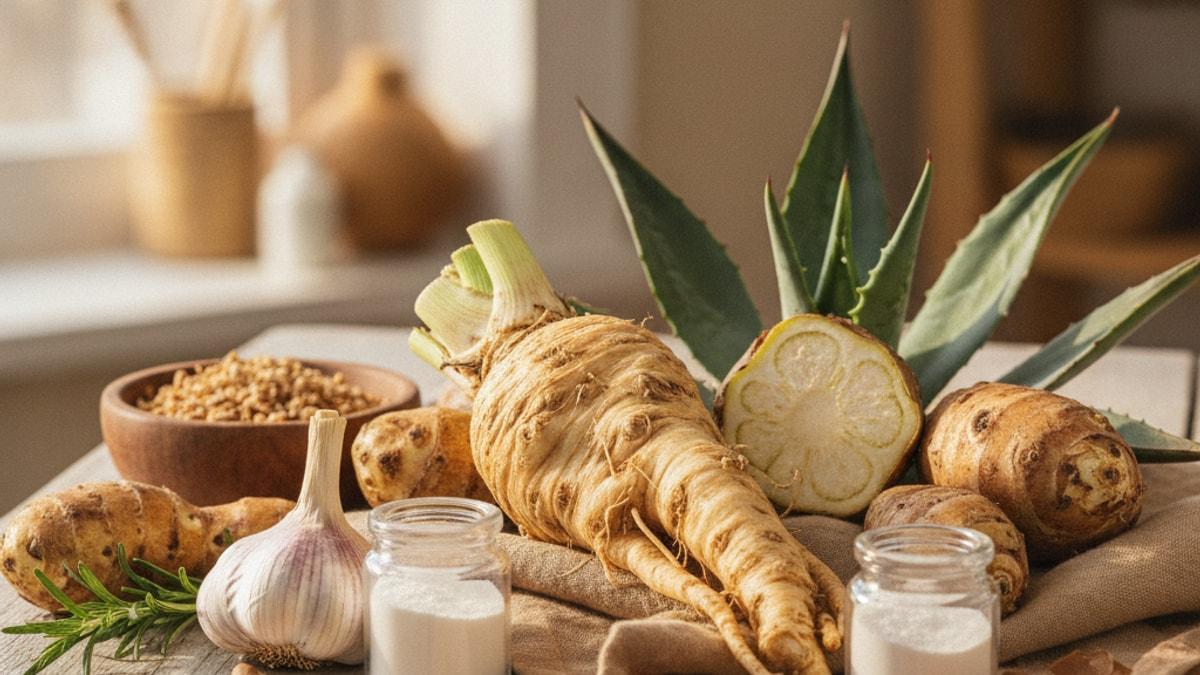
Inulin is made from the underground parts of certain plants. Roots and tubers hold it as a food store. Chicory root sits behind many food ingredients that list this fiber. Jerusalem artichoke tubers are another common starting point. Agave plants hold it in their core. Dandelion root holds it as well.
Chicory is a roadside plant with pale blue flowers. It belongs to the same family as the daisy. Its root is pale and looks like a thin parsnip. A review of lab and nutrition studies describes inulin as a fiber from chicory root, and as food for helpful bacteria in the colon.
Jerusalem artichoke is not an artichoke at all. It is a relative of the sunflower. The part people harvest is a knobby tuber that grows under the soil. A review of lab, animal and human work describes how inulin from Jerusalem artichoke is taken out of the tuber, and how it shapes gut bacteria.
Plenty of everyday foods carry some of this fiber too. Onions, garlic and leeks carry it. So do asparagus, bananas, wheat and dandelion root. Food makers still turn to chicory and Jerusalem artichoke, because those roots are simple to harvest in bulk. A review of animal and human studies describes how inulin supports the gut microbiota, the bacteria living in the gut.
How do plants make and store inulin?
Plants build this fiber themselves. They make sugar in their leaves, using sunlight, water and air. That sugar then travels down into the roots. Many plants pack it away as starch. Some plants pack it away as inulin instead.
Inulin is a chain of fructose units. Fructose is a simple sugar found in fruit and in many plants. A great many of these chains end with a single glucose unit, another simple sugar. The links between the units are what make the chain behave like a fiber rather than a sweetener.
Chain length is not fixed. Some chains are short, with only a few units joined together. Others run much longer. A single root holds a mix of lengths. Short chain material is sometimes sold under the name oligofructose, which comes from the same plants.
The store has a job to do. A chicory plant spends its first year building a thick root. That root is its pantry for the cold months. In spring the plant draws on the pantry to push up a flower stalk. Growers watch the harvest window closely for that reason.
This is also why the fiber sits underground rather than in the leaves. The plant keeps its reserve where frost and grazing animals are less likely to reach it. Harvest crews lift the roots much as they lift sugar beets.
How is inulin taken out of the root?
Hot water does most of the work. The steps look a lot like sugar making. Roots arrive from the field and are washed and sorted. Machines slice them into thin strips. The strips go into hot water, and the fiber moves out of the plant tissue and into the liquid.
Cleaning comes next. Filters take out pulp and fine solids. Further steps pull out color and plant flavors. The clear liquid is then dried into a pale powder. Some production lines stop earlier and sell a thick syrup instead of a powder.
Makers can also sort the chains by length. Shorter chain products and longer chain products can come from the very same root. The sorting step is what sets them apart, not a different plant.
A review of lab, animal and human work describes how inulin from Jerusalem artichoke is extracted from the tuber. A review of animal and human studies describes how this dietary fiber is taken out of plants.
The end result is a plain, pale ingredient. It dissolves in water. Longer chains give food a smooth, creamy feel. Shorter chains dissolve quickly and taste faintly sweet. Food makers pick a grade to suit the recipe.
What does inulin do once it reaches the gut?
It feeds bacteria. Fiber is the part of plant food that the body does not use for fuel itself. The large intestine, also called the colon, holds a dense community of bacteria. A review of lab and nutrition studies describes inulin as food for helpful bacteria in the colon.
The bacteria break the chains apart by fermentation, which means breaking food down without using air. That process makes gases and short fatty acids. The fatty acids are used by cells in the gut wall. The gases are the reason fiber can feel noticeable.
This feeding role is why the fiber is called a prebiotic, a food for the helpful bacteria already living in the gut. A prebiotic is not the same thing as a live culture. One is the meal. The other is the guest.
Tolerance matters here too. A small trial in adults tested a drink made with an inulin-rich roasted chicory extract. [Small human study] That trial, run in two parts with 18 and 35 healthy adults, found the drink was well tolerated. [Small human study] At the larger amount, the same small trial in healthy adults recorded only slight extra abdominal discomfort. [Small human study]
That is a narrow slice of evidence. Readers who want the ground rules behind these labels can see how the studies are read.
Does the source plant change the inulin?
The plant sets the mix of chain lengths. Chicory root and Jerusalem artichoke tubers both store this fiber. The season, the storage time and the factory steps all shape the final mix. So two powders from two plants are not identical.
None of the papers cited here put one plant source against another in people. Each paper stands on its own. A review of lab, animal and human work describes the structure of inulin from Jerusalem artichoke and how it shapes gut bacteria. A review of lab and nutrition studies describes inulin from chicory root as food for helpful colon bacteria.
In the kitchen, the practical differences are about texture and taste. Longer chains behave like a soft fat in food. Shorter chains dissolve fast and add a hint of sweetness. Those are cooking traits, not health claims.
Labels can use several names. Chicory root fiber, chicory inulin and plain inulin all point to the same kind of ingredient. Reading the ingredient panel is the simplest way to see which plant was used.
What studies show
The papers cited here are three reviews and one small trial. Three of them describe where the fiber comes from and what it does for gut bacteria. One tested how a chicory extract drink sat with adults who drank it.
A review of lab and nutrition studies describes inulin as a fiber from chicory root, and as food for helpful bacteria in the colon.
A review of lab, animal and human work describes how inulin from Jerusalem artichoke is extracted, and how it shapes gut bacteria.
A review of animal and human studies describes how inulin, a dietary fiber, supports the gut microbiota and how it is taken out of plants.
A small trial in healthy adults found that a drink made with an inulin-rich roasted chicory extract was well tolerated. [Small human study] The same small trial, in two parts with 18 and 35 healthy adults, recorded only slight extra abdominal discomfort at the larger amount. [Small human study]
What is not known yet
The human evidence on this page is thin. Reviews gather work that already exists. They do not add a new trial of their own.
The small trial in healthy adults ran in two parts, with 18 adults and 35 adults, so the groups were small. [Small human study] That same small trial looked at how the chicory extract drink was tolerated, not at long term use. [Small human study]
No paper cited here compares chicory inulin with Jerusalem artichoke inulin in people. No paper cited here follows people for months or years. No paper cited here covers people who are managing a condition.
The reviews describe gut bacteria work drawn from lab, animal and human studies, so the strength of the evidence varies from point to point. An animal result is an animal result. It is not a finding in people.
Amounts are outside the scope of this page. The Supplement Facts panel on a product is where a serving is described. Anyone with a question about use should follow the label directions.
Key takeaways
- Inulin is a fiber that plants store underground, chiefly in chicory root and Jerusalem artichoke tubers.
- Makers slice the washed roots, soak them in hot water, clean the liquid and dry it into a pale powder or a syrup.
- A review of lab and nutrition studies describes it as a fiber from chicory root and as food for helpful colon bacteria.
- A review of animal and human studies describes how it supports the gut microbiota and how it is taken out of plants.
- In a small trial in healthy adults, an inulin-rich roasted chicory extract drink was well tolerated. [Small human study]
- The human evidence cited here is small and early, so much about this fiber is still open.
Inulin begins as a plant's own pantry and ends up as a pale powder on an ingredient list. The path from root to powder is mostly washing, slicing, hot water and drying. The science so far points to gut bacteria as the part of the body that makes use of it, with small human evidence and plenty of open questions. Anyone wondering whether a fiber supplement suits their routine can talk with a healthcare provider. There are more questions answered elsewhere on this site, along with common questions.
Reverra products are for healthy adults. Talk to your healthcare provider before starting any supplement, especially if you take medication, manage a condition, or are pregnant or nursing.
These statements have not been evaluated by the Food and Drug Administration. Reverra products are dietary supplements and are not intended to diagnose, treat, cure, or prevent any disease.
Common questions
What is inulin made from?
Inulin is made from plants. Growers take it from roots and tubers, such as chicory root and Jerusalem artichoke. Agave and dandelion root hold it as well. The plant material is washed, sliced and soaked in hot water. The liquid is then cleaned and dried into a pale powder.
Is chicory root fiber the same thing as inulin?
Chicory root fiber is a common name for inulin taken from chicory. Chicory is a daisy relative with pale blue flowers and a pale root. Labels may use either name. Some labels name shorter chain versions instead, which come from the same root and are sorted during processing.
Does inulin ever come from an animal source?
No. Inulin is a plant fiber. Plants build it as a way to store energy underground, in place of starch. No animal material is used to make it. That is why ingredient panels group it with plant fibers rather than with ingredients of animal origin.
Is inulin a sugar?
Inulin is built from fructose units, which are simple plant sugars, and many chains end with a glucose unit. Those units are joined into long chains. Because of the way the links are arranged, inulin behaves as a fiber in food rather than as a sweetener. Short chains taste faintly sweet.
What does prebiotic mean?
A prebiotic is a food for the helpful bacteria already living in the gut. The person does not use the fiber as fuel, but the resident bacteria can. Inulin is studied as one of these fibers. The idea is simple: feed the bacteria that already live in the large intestine.
Is inulin made in a factory or by the plant?
The plant makes it, and a factory only separates it out. Workers wash and slice the roots, then soak the slices in hot water so the fiber moves into the liquid. Filters remove the solids, the liquid is cleaned, and drying leaves a pale powder or a thick syrup.
Which everyday foods contain inulin?
Onions, garlic, leeks, asparagus, bananas, wheat and dandelion root all carry some. Chicory root and Jerusalem artichoke are the plants food makers usually harvest for it, because the roots are easy to lift in bulk. How much a food holds depends on the plant, the season and storage.
Why does fiber like inulin make gas?
Bacteria in the large intestine break fiber down by fermentation, which means working on food without air. Gas is a normal by-product of that process, along with short fatty acids. Some people notice it more than others. Anyone with questions about how a fiber suits them can ask a healthcare provider.
How should someone use an inulin supplement?
Follow the label directions. An article cannot say when or how often to take a supplement, and this page gives no amounts. The Supplement Facts panel on the package is where serving information lives. Anyone taking medication or managing a condition should speak with a healthcare provider first.
Does the source plant change the fiber?
Chain length can differ by plant, by growing season and by how the roots were stored and processed. Shorter chains dissolve quickly and taste faintly sweet. Longer chains give food a smoother feel. What those differences mean for people has not been sorted out by the research cited here.
References
- 01Inulin: A novel and stretchy polysaccharide tool for biomedical and nutritional applications, 2019 PMID 30926495
- 02Deciphering inulin from Jerusalem artichoke: Extraction, structural characteristics, bioactivities, structure-activity relationship, modifications, pharmacokinetics and applications, 2025 PMID 40945254
- 03Inulin-A polysaccharide: Review on its functional and prebiotic efficacy, 2022 PMID 36166490
- 04Gastrointestinal tolerance to an inulin-rich soluble roasted chicory extract after consumption in healthy subjects, 2010 PMID 19931416
Keep reading
This article is for general information and is not medical advice. These statements have not been evaluated by the Food and Drug Administration. Reverra products are not intended to diagnose, treat, cure, or prevent any disease. Consult your healthcare provider before starting any supplement.